
























IaaS, PaaS, SaaS: Choosing the most relevant solutions for your business
- What Is GCP?
- Google Cloud Platform Infrastructure, Regions, and Zones
- About Google Cloud History
- The Benefits of Google Cloud Platform
- What Is Google Cloud Platform Used For?

- Beyond Infrastructure: The Extended Google Cloud Ecosystem
- Security in Google Cloud Platform
- How Much Does Google Cloud Platform Cost?
- Transform Your Business Fast with an Official Google Cloud Partner
Google Cloud 04.10.2024 


What Is GCP and How Can You Use It for Your Business?
- What Is GCP?
- Google Cloud Platform Infrastructure, Regions, and Zones
- About Google Cloud History
- The Benefits of Google Cloud Platform
- What Is Google Cloud Platform Used For?
- Beyond Infrastructure: The Extended Google Cloud Ecosystem
- Security in Google Cloud Platform
- How Much Does Google Cloud Platform Cost?
- Transform Your Business Fast with an Official Google Cloud Partner
You have probably already heard of Gmail, Google Maps, Google Docs, Google Meet, and so on. These products are often on your radar, even if you don’t use Google’s toolkit. But are you familiar with the Google Cloud Platform and how it works?
Cloud technologies have increasingly grown in popularity in recent years. That’s understandable since the trend of businesses going online has skyrocketed. It had started even before the pandemic, but we can not ignore the Covid’s impact on this tendency. When talking about migration to the cloud, we always think of the market-leading cloud technology providers, and Google Cloud is definitely among them.
In this blog, as a global Google Cloud Premier Partner, we highlight one of the essential elements in building a business online — Google Cloud Platform (GCP) — plunge into some solutions you may not have known, and delve a little deeper into the history to introduce you to the product.
What Is GCP?
Google Cloud is a collection of services that can help large, medium-sized, and small businesses go digital. The Google Cloud Platform is also part of the Google Cloud, which provides a place to deploy and host your web applications.
It runs on the same infrastructure used for Googles end-user products and provides modular services for computing, data storage, data analytics, and machine learning. Available in multiple regions and zones globally (more on that below), GCP offers a variety of tools, libraries, and services for developing, deploying, and managing applications in the cloud.
What GCP is known for is an extensive catalog of services, global recognition, and competitive pricing. It has experienced significant growth and profitability, outperforming analysts’ projections to post a record US$9.5B+ in revenues for the first quarter of 2024. The figure marks a heightened need for cloud computing resources ignited by the influx of GenAI tooling.
GCP’s advantages include its robust, scalable, and reliable infrastructure, as well as strong partnerships with companies like NetApp and Radisys Corporation. It also offers a Platform-as-a-Service (PaaS) model and allows users to trial its services. SMBs can use GCP for free or at a low cost, making it an attractive option for cost-effective data and application management.
You need Google Cloud Platform services to create not just a standard website but a web application that will help your customers. For example, you sell furniture and would like to create an application on your site to calculate the size of the closet that would fit your customer’s apartment. Or, you’re making a sports portal, and you need to give coaches the ability to analyze their players’ body measurements to see who should get in shape. What is GCP’s role here? Well, by putting such an interactive application onto your website, you not only deliver quality and convenient services but also create a good image for your brand.
You can also use the Google Cloud Platform when you need an application with:
- Artificial Intelligence (learn more about Gemini for Google Workspace);
- Powerful analytics;
- Massive data center;
- Massive data storage;
- Cost-efficiency benefits.
At the same time, GCP charges you only for the services you use, and not for the entire system at once.
“Google is truly a reliable leader in the field of cloud computing. We can meet the needs of our projects using GCP services, all while getting all the necessary tools for tracking. Migrating a portion of our infrastructure from bare metal to the cloud is fast and trouble-free.” — Roman Pozhar Head of DevOps, appflame
Overall, Google Cloud Platform is a comprehensive and popular cloud computing service that enables businesses to build, deploy, and manage applications with ease. With its strong infrastructure, competitive pricing, and strategic partnerships, GCP is well-positioned to meet the needs of enterprises worldwide.
Google Cloud Platform Infrastructure, Regions, and Zones
Google Cloud Platform’s infrastructure is built upon a private, software-defined network that is powered by edge, cloud CDN, and media CDN points of presence. In total, GCP is available in more than 200 countries and territories via 40 regions, 121 zones, and 187 network edge locations.
Some of the latest region additions are Berlin (Germany), Doha (Qatar), Dammam (Saudi Arabia), and Johannesburg (South Africa). What is GCP planning up next? Extending coverage to Mexico, Austria, Greece, Norway, Sweden, Malaysia, Thailand, and New Zealand.
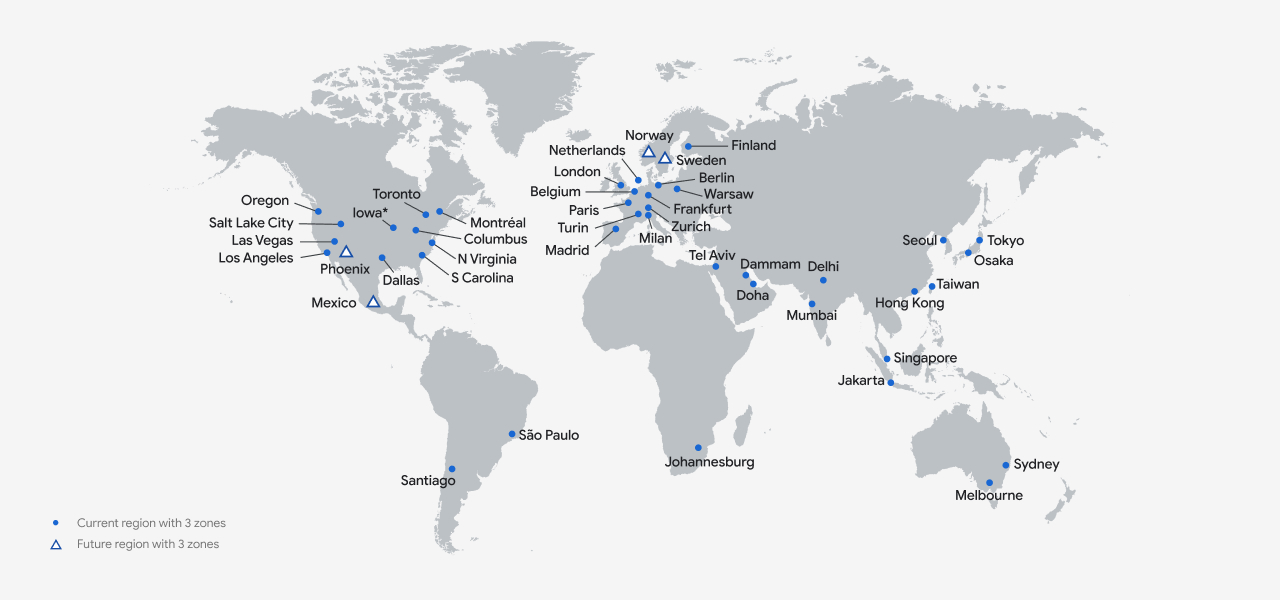
Cloudfresh can consult you on a suitable location based on a combination of variables such as required latency, affordability, and level of GHG emissions.
Now, to better understand how Google Cloud became the platform it is today, let’s rewind a bit.
About Google Cloud History
Google launched its Google App Engine in April 2008 as a beta version, providing users with a platform to create and deploy web applications using various common technologies, such as Python, Node.js and PHP. The aim was to provide a hassle-free infrastructure so that developers could easily roll out applications and scale them as demand grew.
At the time, the company already had a competitor from Microsoft (check out our comparison of AWS vs Azure vs Google Cloud). The first release aimed to test the platform, so GCP (at the time, App Engine) was available to over 10,000 developers. They could use 500 MB of storage, 200 million megacycles of CPU, and 10 GB of bandwidth per day.
Trial runs with the service ended in 2011, at which point Google announced GCP as its official product. Now, companies such as Nintendo, eBay, UPS, The Home Depot, Etsy, PayPal, 20th Century Fox, and Twitter use Google’s cloud services. It’s estimated that the world will store 100 zettabytes (1 billion terabytes) of data in the cloud by 2025.
The Benefits of Google Cloud Platform
What is GCP’s influence on intra-organizational performance? To answer that question, research was commissioned from the International Data Corporation (IDC) — a company that provides high-profile intel on markets worldwide. The findings were nothing short of promising:
- A 222% return on investment (ROI) observed over the 3y timeframe;
- A 41% improvement in efficiency measured across multiple IT teams;
- A 26% reduction in costs pertaining to IT infrastructure;
- A 19% boost to developer productivity.
Want to achieve similar results? Book a free consultation with our certified cloud optimization specialists! Reach out today →

What Is Google Cloud Platform Used For?
We’ve already covered the general information about Google Cloud Platform and its main features. Now, let’s look at some primary services and GCP use cases.
The Main Services of the Google Cloud Platform
GCP includes several products, and the platform’s services depend on the region in which the center is located. The functions of GCP also depend on which area the Google GCP office is running in. Nevertheless, the core services are divided into the following categories, with some of the Google Cloud Platform products relevant to each of them:
- Compute (Compute Engine, App Engine, Kubernetes Engine, Container Registry, Cloud Functions);
- Storage and database (Cloud Storage, Cloud Bigtable, Cloud Datastore, Cloud SQL);
- Networking (Cloud Virtual Network, Cloud Load Balancing, Cloud CDN, Cloud Interconnect, Cloud DNS);
- Management tools (Monitoring, Logging, Error Reporting, Trace, Debugger, and others);
- Big Data (BigQuery, Cloud Dataflow, Cloud Dataproc, Cloud Datalab, Cloud Pub/Sub, Genomics);
- Machine learning (Cloud Machine Learning Platform, Vision API, Speech API, Translate API);
- Developer tools (Cloud SDK, Deployment manager, Cloud source repositories, Cloud endpoints);
- Identity & Security (Cloud IAM, Cloud Resource Manager, Cloud Security Scanner, and others).
Google Cloud Platform for Business: Use Cases
Now let’s break down some of the use cases of Google Cloud for small businesses and large enterprises to better understand how it works in practice.
- As for large companies with numerous departments, you must properly create a hierarchy in which each department can work at its own pace but under general guidance. GCP helps create and manage policies within a company with little difficulty. When removing projects from the platform, GCP automatically removes project material from everywhere, saving unnecessary costs in the future.
- For businesses that care about using machine learning or analytics, GCP will be also advantageous. It gives its customers broad access to machine learning data, an advantage that is very significant for large companies. Together with the data GCP provides, companies can use additional key information about their products to improve them. Vertex AI is one of the most well-known services that accelerates ML and builds Generative AI apps. With this service, you can deploy and scale machine learning using game-changing AI for any case (e.g., cloud adoption in financial services).
- If your organization requires more infrastructure scalability and agility than a traditional data center can provide, the GCP will cover you up. Here you can use, for example, the Compute Engine, a computing tool that allows you to run virtual machines on Google’s infrastructure. With this solution, you can quickly scale and process large volumes of data in seconds to run your business operations smoothly. You can learn more details in our success case with Air.io.
- If you are an organization desiring to speed up your data processing operations without buying additional services, you can also profit from GCP. Here, the BigQuery service enters the game. Being a serverless multi-cloud data warehouse, Big Query can help you securely store your data, facilitate the work of analysts, and pay only for the processed data, which is convenient for small and large businesses alike. If you want to discover more about the role of BigQuery in improving your work with data, you are welcome to read the MacPaw success case.
“Google Cloud services are a whole world of tools that allow you to increase the efficiency of working with data and provide convenience at all stages of work. Our team uses many Google features to store our infrastructure, data processing, and A/B testing. It completely closes our need to obtain and analyze data, test hypotheses, and, accordingly, scale our business.” — Rostyslav Vasiukov, Head of Engineering, Headway.
Google Cloud is not limited by these particular use-case advantages, though. There’s a wide range of GCP benefits and unique features that can help your business scale, regardless of the industry you’re in.
What to Expect from Google Cloud Platform in 2024
Google Cloud Platform (GCP) is constantly evolving, offering new features and updates that can benefit businesses of all sizes. Here’s a rundown of some of the latest offerings that can help you stay ahead of the curve and optimize your cloud operations:
- Edge Computing Dominance: Google Cloud’s edge computing capabilities, such as GKE Enterprise, are enhanced to bring computational power closer to the data source. This reduces latency and improves overall performance, essential for businesses requiring real-time data processing.
- AI and Machine Learning Integration: Google Cloud continues to integrate AI and ML into its services. Tools like TensorFlow and AI Platform empower businesses to leverage advanced analytics, automate processes, and gain insights from data, making these technologies more accessible and impactful for various business operations.
- Hybrid and Multi-Cloud Strategies: Google Cloud’s GKE Enterprise allows organizations to build and manage applications across different environments. This is crucial for businesses adopting a mix of on-premises, private cloud, and public cloud solutions, providing flexibility and scalability.
- Enhanced Security Measures: Security is a top priority, and Google Cloud introduces more robust security measures like BeyondCorp and Confidential Computing. These solutions ensure data protection and compliance with industry regulations, which is vital for businesses concerned about data security.
Beyond Infrastructure: The Extended Google Cloud Ecosystem
While compute engines and storage buckets form the backbone of the cloud, successful digital transformation requires tools that sit on top of that infrastructure. Google offers a comprehensive suite of SaaS and PaaS solutions designed to modernize how your teams collaborate, how you analyze data, and how you engage with customers. Below is an overview of the key products that turn raw cloud power into tangible business results.
Google Workspace
Modern work isn’t tied to a desk. Google Workspace provides a flexible, innovative environment for your team to connect and collaborate from anywhere, on any device. It goes beyond simple email and docs; it is an enterprise-grade ecosystem that ensures real-time collaboration while keeping your data and devices secure. Whether you are a startup or a global corporation, Workspace streamlines communication and drives impact.
Google Voice
Communication systems shouldn’t be complicated. Google Voice is a smart, scalable internet telephony service that uses Voice over IP (VoIP) to seamlessly connect all your user phone numbers. It integrates perfectly with the Workspace ecosystem, offering an easy-to-use interface that allows your team to stay reachable and professional without the need for clunky hardware or complex setups.
Google Maps Platform
Location data is a goldmine for business insights. Google Maps Platform allows you to transform your operations with real-world context. From optimizing delivery routes in real-time to creating interactive customer experiences on your website, this tool leverages comprehensive geospatial data. It’s about helping your users—and your business—navigate the world with precision and simplified planning.
Customer Engagement Suite with Google AI
Customer service is evolving from reactive to proactive. The Customer Engagement Suite (formerly Contact Center AI) automates interactions and empowers human agents to solve complex issues faster. Using industry-leading AI, you can deploy virtual agents that handle natural conversations, acting as “superheroes” for your customers while providing your team with actionable insights to improve satisfaction scores.
Google Chrome Enterprise
Managing a fleet of devices can be a security nightmare without the right tools. Google Chrome Enterprise provides a license to effectively manage your Chrome IT infrastructure. It connects OS Chrome devices with the browser users, ensuring maximum cooperation, robust data protection, and performance improvements. It gives IT teams the control they need while giving employees the speed they love.
Chrome OS Flex
Don’t let perfectly good hardware go to waste. Chrome OS Flex is a sustainable operating system that turns old PCs and Macs into fast, secure, and manageable cloud-first devices. It maximizes compatibility and extends the life of your existing fleet, offering a safe design and simple management that reduces e-waste and hardware costs simultaneously.
Apigee
In a connected world, APIs are the bridges between services. Apigee enables companies to manage the full API lifecycle with precision. Now enhanced with AI, it helps you reinforce security and handle high traffic demands without bottlenecks. From API-first integration to monitoring and hybrid deployment, Apigee ensures your digital ecosystem remains reliable and performant at any scale.
BigQuery
Data is useless if you can’t analyze it fast. BigQuery is a unified, AI-ready platform that goes far beyond a traditional data warehouse. It transforms how you work with data by offering a fully managed, serverless analytics environment. With support for multiple engines and formats, BigQuery helps you extract real-time predictive insights and share them securely across your organization.
Looker
Data needs to be understood, not just stored. Looker empowers data analysts with a robust business intelligence platform while simplifying data consumption for non-technical users. Through solutions like Looker Studio and Looker Studio Pro, it offers a single platform for all your BI needs. It accelerates time-to-value, helping your company operate smarter by making data-driven decisions accessible to everyone.
Google for Education
The classroom of the future is here. Google for Education provides a suite of tools that work together to transform teaching and learning. It creates a simple, secure environment where every student and educator can pursue their potential. With versatile devices and intuitive management systems, it’s the easiest way to connect classes and foster a managed education ecosystem.
Google Cloud for Government
Public sector agencies face unique challenges regarding security and compliance. Google Cloud for Government, offered by Cloudfresh, ensures safe and secure cloud infrastructure available 24/7. It allows agencies to pay only for the instruments they use, eliminating depreciation costs while adhering to world-class security standards. It’s the path to digital government without compromising on safety.
Google Cloud for Startups
Every unicorn started small. The Google Cloud for Startups program is designed to boost your performance from day one. It provides eligible startups with cost coverage, access to leading industry experts, and technical support. By following best implementation practices and connecting with experienced mentors, you can build your product quickly and thrive in a competitive market.
Google Maps Platform for Retail
In the age of e-commerce, the physical and digital worlds must merge. Google Maps Platform for Retail makes shopping easier and more engaging. By integrating precise location data, you can help customers find stores, check inventory nearby, and enjoy a seamless checkout experience, ultimately driving foot traffic and increasing conversion rates.
Google Maps Platform for Logistics
Efficiency in logistics is measured in seconds and meters. Google Maps Platform for Logistics transforms your operations by using the power of geospatial data to dynamically track fleets, assets, and devices. It allows for precise route planning and real-time adjustments, helping you reduce fuel costs, improve delivery times, and manage your supply chain with total visibility.
Google Maps Platform for Financial Services
Trust and location go hand in hand. Google Maps Platform for Financial Services elevates the customer experience while reducing risk. By using geospatial data, banks and insurers can verify transactions, assess property risks more accurately, and help customers locate branches or ATMs effortlessly, increasing operational efficiency and security.
Google Maps Platform for Real Estate
Location is everything in real estate. Google Maps Platform for Real Estate enriches the home search experience for your customers. With advanced map-based tools and visualization features, you can provide detailed neighborhood insights and immersive property views, helping buyers make informed decisions faster and keeping them engaged on your platform.
The GenAI Future
The revolution isn’t coming; it’s already here. The GenAI future represents the next frontier of business innovation. Don’t lag behind—discover what’s next with Google Cloud’s GenAI, supported by Cloudfresh. We help you navigate this change with confidence, creating a strategy that integrates generative AI into your workflows to bring tangible business results.
Gemini Code Assist
Speed up your software development lifecycle (SDLC) without sacrificing quality. Gemini Code Assist is your smarter AI companion for coding. Developed by Google Cloud, it brings speed, security, and precision to your development process. It helps developers write code, debug, and understand complex codebases faster, making your engineering team more productive and agile.
Gemini Enterprise (formerly Agentspace)
Unlock the full potential of enterprise AI with Google’s most advanced platform. Gemini Enterprise now integrates the powerful Agentspace technology, giving every employee a capable AI teammate. Whether you need ready-made experts or want to build custom AI agents that understand your unique workflows, this unified solution turns your data into intelligent action—securely and at scale.
Security in Google Cloud Platform
Being a top-notch cloud services provider, it’s natural that Google is under constant regulatory scrutiny. To ensure that user data remains safe and private at all times, GCP has secured compliance with a number of industry- and country-specific standards (i.e., ISO/IEC 27001, ISO/IEC 27017, ISO/IEC 27018, SOC 1, FISC (Japan), and FedRAMP).
So, what is GCP doing in terms of cybersecurity? It offers solutions for various scenarios, among which are:
- Google Threat Intelligence: Monitoring millions of attacks and investing hundreds of thousands of hours into their investigation, Google possesses unrivaled visibility it’s eager to share with your organization;
- Mandiant Attack Surface Management: Get a second professional opinion on the possible vectors of attack on your networks, accounting for the unknowns as well as areas leaving you exposed;
- VirusTotal prevents breaches by contextualizing your internal logs and observations;
- Mandiant Security Validation represents a ‘sandbox’ of sorts, highlighting the expected efficiency of your security controls via simulated attacks;
- Mandiant Digital Threat Monitoring lets you glimpse the darkest corners of the web to find out if any of your corporate data, such as credentials, has suffered a leak.
In case of an incident, a Google Cloud Backup and Disaster Recovery plan would also help.
How Much Does Google Cloud Platform Cost?
Since GCP operates on the pay-as-you-go model, your expenses will depend on the set of particular products and services used and their consumption. Other pricing components to factor in include machine type, server location, and commitment duration.
The good news is that Google Cloud Platform charges no upfront or termination fees. Moreover, it provides users with a dedicated calculator to help them estimate expenditures with confidence and later, an AI-powered, single-pane-of-glass view of all their budgeting, alerts, and quotas.
Transform Your Business Fast with an Official Google Cloud Partner
To wrap it up: GCP is one of the largest cloud providers, offering a suite of computing services for data management, artificial intelligence, and machine learning tools. GCP’s services can expand your business and help you scale to new frontiers. It’s not an easy process, but it’s definitely worth the effort.
If you’re curious about the best practices for a successful cloud migration, don’t miss our guide on developing a winning cloud migration strategy.
Learning the GCP platform also has its benefits. You can take advantage of Google certifications or contact the Cloudfresh team for training and help with platform integration.
Being a Google Cloud Premier Partner, we have a sophisticated team of certified professionals who can guide you through all stages of your journey with Google Cloud.
Our Cloudfresh provides Google Cloud consulting services to help you optimize your IT infrastructure, ensure hassle-free migration to Google Cloud and rapid implementation, and unlock cost-saving opportunities to get the most out of your cloud investments.

Get in touch with Сloudfresh