



























Why It Is Essential to Implement Asana Together with an Official Partner
Asana 26.02.2026 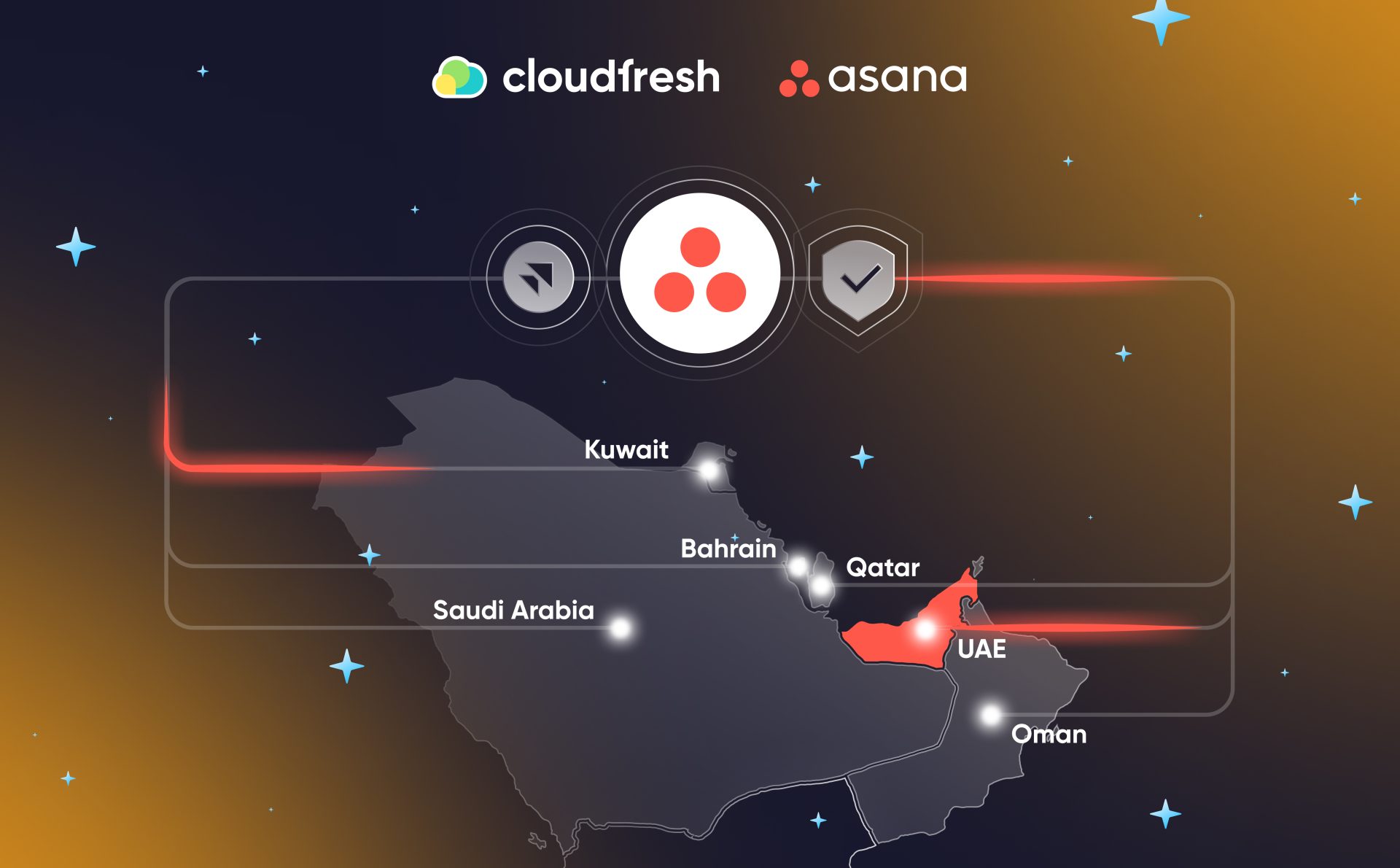


Latency Is Revenue (Whether We Admit It or Not): The ‘Why’ behind Asana’s Data Center in AWS Middle East (UAE)
Asana has officially revealed its AWS-backed UAE data center. It goes without saying that this is a great milestone and big data residency news, but why exactly does it carry such weight?
Hi! My name is Norbert Durko. I’m a General Manager for Cloudfresh Middle East, and Cloudfresh is an official Asana Platinum Solutions Partner that has won the Solutions Partner of the Year award in EMEA.
Today, I’ll share my vision on the first-ever work management platform to gain data residency in the United Arab Emirates.
When Governments Move, Markets Follow
To begin with, I’ve spent the past few years listening to executives talk about growth, innovation, and global scale. Lately, the tone has changed. The conversations feel heavier. More cautious. More geopolitical.
We are no longer building in a borderless digital world.
According to Deloitte, 65% of governments are expected to introduce technology sovereignty requirements by 2028.
That statistic stopped me in my tracks the first time I saw it. Just think about it: two out of three governments are moving to take tighter control over information and infrastructure within their borders.
That’s not a policy tweak. That’s a shift in philosophy.
At the same time, money tells its own story.
Gartner projects that sovereign cloud infrastructure as a service (IaaS) will reach US$80.4 billion in 2026, a 35.6% increase in just one year. Around 20% of infrastructure workloads are already moving from global cloud providers to local or regional ones.
And if that sounds aggressive, consider this: Boston Consulting Group forecasts that sovereign IaaS spending will climb to US$169 billion by 2028, growing at roughly 36% annually.
When capital moves this quickly, it reflects something more than just fashion.
From where I sit, this is not simply about compliance. It’s about control, trust, and resilience in a world that feels less predictable than it did a decade ago.
For years, we celebrated the idea of the cloud as placeless. Infrastructure was abstract. Location barely mattered. If anything, global distribution was the selling point.
But laws still apply. Politics certainly still applies.
I’ve come to believe that regional hosting is a leadership, not a technical, decision.
Looking for an Asana Partner in the UAE? Our certified experts will hold a personalized consultation for your team. By the time it ends, you’ll have your specific data residency concerns answered once and for all. Book Now →

Performance Still Runs on Physics
Let me start with the practical side, which is performance.
When I talk to product leaders, I ask, “Where are your users, and where are your servers?” The answer often reveals a hidden gap.
Latency is just the time it takes for information to travel from a user to a server and back. But that “just” hides the real deal. If your employee is in Abu Dhabi and your server is in Dubai, the delay is almost zero. Move that server to Sydney, and the round-trip time jumps to hundreds of milliseconds.
That number may not sound too dramatic. But users feel it. They may not always tell you about it, but they definitely know when software lags.
These days, teams demand a native-feeling, nearly lightning-fast experience. When hosting closer to the user, SaaS platforms can deliver not only that, but also a massive competitive advantage. In industries like financial trading or multiplayer gaming, even a millisecond can change everything.
Resilience Is About Containing the Blast Radius
Performance is not only about speed. It’s also about resilience.
When infrastructure is concentrated in a single distant region, the risk profile changes. A storm hits. A power grid fails. A fiber cable is cut. Suddenly, hundreds or thousands of your workers are affected. The blast radius is wide.
When workloads are distributed across defined regions, failure becomes contained. One region goes dark. Others continue operating. Users outside the affected zone may not even notice.
I’ve come to see regionalization as disciplined risk containment. It limits how far a single incident can spread. There’s also the human factor. If your primary IT team and network operations center are in the same region as your infrastructure, incident response improves.
Moreover, every time information crosses borders, it travels through routers, exchanges, and third-party networks. But what do fewer hops really mean? First and foremost, it makes it easier to map data flows for compliance auditors, which is something you can’t meet strict data residency rules without.
I’ve also seen businesses try active-active, cross-continent disaster recovery. Interesting, on paper. In practice, real-time sync struggles when latency goes up. Data must be quick to move between facilities to avoid loss. That only works when those facilities are geographically close enough.
But the technical argument, strong as it is, is no longer the main driver.
The Regulatory Conversation Has Changed the Room
I find it helpful to distinguish between data residency and compliance, because the two are often mixed up.
Data residency is about where information physically lives and is processed. Many enterprise buyers and government contracts now require that data never leave national borders. EU information must remain in the European Union. UAE public sector data must stay in the United Arab Emirates. These are not preferences. They are contractual mandates.
Compliance, on the other hand, is about following specific legal frameworks such as the FedRAMP, 2023 National Cloud Security Policy, and ISO 27001.
In my experience, regional hosting makes compliance conversations a lot easier. When data never leaves a clearly defined jurisdiction, there’s much less stress around audits. Legal teams breathe easier, and sales cycles shorten.
I’ve watched B2B deals stall for months because a buyer insisted on local data residency. The vendor had strong security controls, strong encryption, and strong policies in place. None of it mattered, though. Why? Well, the data crossed a border. Simple as that.
But when that same vendor could say, “We can provision an isolated instance in our data center that meets UAE data residency requirements,” the deal moved forward.
Something similar happened when we partnered with Washmen, the #1 app-based laundry, dry cleaning, ShoeCare, and Bag Care service in the country:
“Asana’s availability in the AWS Middle East (UAE) Region is a meaningful step for organizations building technology-driven operations. For Washmen, founded on the belief that traditional services can be reimagined through science and technology, local hosting strengthens the speed, reliability, and scalability needed to support a sophisticated operational ecosystem.
With infrastructure now closer to the market, Washmen can further evolve its technology-driven operations, expand intelligent automation across its service ecosystem, and continue delivering an unparalleled experience to its customers.” 
With infrastructure now closer to the market, Washmen can further evolve its technology-driven operations, expand intelligent automation across its service ecosystem, and continue delivering an unparalleled experience to its customers.”

Co-Founder & COO at Washmen
For private companies, regional hosting is not about ideology. It’s about revenue, retention, and market access.
For governments, the stakes are higher.
Tax records, national health registries, military logistics, and classified communications are all managed by the public institutions. That translates to the need for local data centers that satisfy strict compliance mandates, government preferences, and absolute jurisdictional control.
Continuity is just as important. If international connectivity is disrupted, whether by accident or geopolitical tension, governments must continue to function. Emergency services, benefits systems, and public portals can’t depend entirely on cross-border links.
I’ve also seen another layer of motivation, which is economic policy.
When governments require data to be hosted domestically, cloud providers respond by building local data centers. That creates jobs. It stimulates demand in construction and energy. It keeps taxpayer money circulating within the national economy.
In that sense, cloud infrastructure becomes industrial policy.
All of this is happening while sovereign AI gains attention as a strategic asset. Meanwhile, Europe is tightening enforcement through measures like the EU Data Act. The direction of travel is unmistakable. Digital autonomy is rising on national agendas.
Using Asana Already? Schedule a quick consult to see how we can help you switch to the UAE data center and stay compliant with local regulations. Schedule Now →

Infrastructure Is Now a Board-Level Decision
So, where does this leave leadership?
In my view, we can no longer treat infrastructure decisions as purely technical. They are geopolitical decisions. They are regulatory decisions. They are brand decisions.
Risk management cannot sit in a silo. CISOs, CIOs, legal teams, and boards must align on where information lives and why. Static policies will never keep up with AI-driven systems and cross-border data flows that are getting increasingly complex.
We need adaptive governance. We need stronger encryption and RBAC practices. We need clear visibility into data location and movement. And that’s exactly what Asana has to offer.
At the same time, I do not believe the answer is isolation. Global cloud platforms still offer scale, innovation, and cost advantages. You just need to find balance.
That’s why I see more organizations building out hybrid and multi-cloud architectures. Some are adopting mesh models that distribute ownership across business domains while respecting regional boundaries.
These approaches acknowledge reality. They accept that we live in a world of overlapping jurisdictions.
The companies and institutions that win in 2026 and beyond will not view data residency as a burden to work around. They will treat it as a trust signal.
Trust with regulators. Trust with customers. Trust with citizens.
To me, that is the real shift. We are moving to an accountable regional presence.
Leadership must change accordingly. The job is no longer simply to integrate systems across borders, but to operate confidently within them.
And in times when control, resilience, and credibility become more important than ever, that may turn out to be a competitive advantage rather than a constraint.
How Cloudfresh Can Help with Asana Data Residency & Beyond
A Dubai office is a major part of our international operations, meaning we have a nuanced understanding of both business and cultural contexts in the United Arab Emirates, Saudi Arabia, Qatar, Kuwait, Oman, and Bahrain.
If you’re interested in how your organization can make the most of Asana in general and its AWS Middle East (UAE) data center and residency that comes with it in particular, you’re more than welcome to fill out the short form below.

Get in touch with Сloudfresh