

























The Best AI Tools for Business across Various Functions
- When APIs Become the Bottleneck
- What Is Apigee?
- The Tipping Point: When You Need It
- Benefits for the Business
- Benefits for Developers

- Real-World Use Cases
- Is Apigee Right for You?
- About Cloudfresh: Your Apigee Partner
Google Cloud 03.04.2026 


What Is Apigee? A Look at Multi-Industry API Management
- When APIs Become the Bottleneck
- What Is Apigee?
- The Tipping Point: When You Need It
- Benefits for the Business
- Benefits for Developers
- Real-World Use Cases
- Is Apigee Right for You?
- About Cloudfresh: Your Apigee Partner
The way companies think about APIs has changed big time. They’re no longer seen as backend plumbing or a cost to manage. Today, APIs bring in revenue.
Recent industry data from Postman shows that around 65% of organizations now make money from their APIs, either directly or indirectly. That’s a clear signal that APIs have moved from support tools to core business assets.
Things are only speeding up. By the end of 2026, a large share of new API demand will come from AI tools and apps, Gartner says. As AI systems move into everyday business use, APIs will be the main way they interact, buy, and make data-driven decisions.
There’s another important change happening. Instead of exposing raw data and hoping someone figures it out, companies are starting to deliver answers. Modern approaches let AI systems pull exactly what they need and act on it in real time.
API solutions are adapting to support this. What is Apigee doing, in particular? The market-leading API management platform has integrated Agent Development Kits (ADKs) that allow developers to plug custom AI agents directly into enterprise APIs with minimal setup. That means better visibility and tighter control, all in one place.
When APIs Become the Bottleneck
As companies grow, their systems get messy. It happens almost every time.
What starts as a few simple integrations turns into a web of connections. Different teams build APIs their own way, so standards start to drift, and things inevitably pile up.
Soon, problems show up everywhere. For one, security rules don’t match. Then, traffic spikes crash older systems. Besides, developers waste time rewriting the same logic instead of building useful features.
Worse, even a small change can break everything downstream. And without clear visibility, fixing issues takes far too long.
APIs are supposed to speed things up. Without structure, they do the opposite.
At some point, every team hits the same realization: building APIs is one thing, and managing them is another.
What Is Apigee?
At its core, Apigee is an API management platform built for enterprise needs.
Instead of letting apps connect directly to your backend systems, everything goes through an Apigee proxy. That layer sits in between and keeps things stable.
Your backend teams can update systems without breaking anything for users. At the same time, you stay in control.
From this single layer, you can:
- Manage access.
- Enforce security rules.
- Monitor traffic in real time.
- Protect systems from sudden spikes.
It’s a clean way to bring order to growing complexity.
The Tipping Point: When You Need It
Most companies don’t start with Apigee. They adopt it when things start to hurt.
The signs are hard to miss.
Different teams publish APIs in different ways. Partners need access, but there’s no clear control, and onboarding takes weeks. Security demands grow, while API traffic becomes unpredictable.
Moreover, debugging gets harder as legacy systems slow everything down. Last but not least, opportunities to monetize APIs slip by.
At that point, managing APIs manually no longer works. You need a proper system in place.
Leave no Room for API Chaos with Apigee Explore how Apigee can help you manage, secure, and scale APIs without adding complexity to your architecture. Explore Now →
Benefits for the Business
What Apigee is offering isn’t just a technical upgrade.
- Teams launch new apps and features faster because they’re no longer tied to fragile systems.
- Data becomes a product, allowing you to package APIs, set their pricing, and create new revenue streams.
- Developers spend less time on repetitive work and more time building what matters.
- Security improves, risks go down, and compliance becomes easier to manage.
- Partners can get started quickly through a self-service portal, instead of long onboarding cycles.
- In the middle of high-traffic moments, your systems stay up and running.
- Teams can launch custom AI agents faster because they no longer have to build security, routing, and rate-limiting logic for every new LLM project from scratch. Apigee handles it all at the gateway.
Benefits for Developers
For developers, the difference is immediate.
Common tasks like authentication, traffic management, and data transformation are handled at the platform level. No need to rebuild them every time.
Older systems can be modernized without rewriting everything. SOAP can become REST. XML can become JSON.
Security is handled at the edge, before requests even reach internal systems.
Debugging is faster, thanks to built-in analytics and tracing tools.
And APIs can be treated like code—versioned, tested, and deployed through CI/CD pipelines.
Deployment Flexibility
One of the biggest challenges for many companies is where data lives.
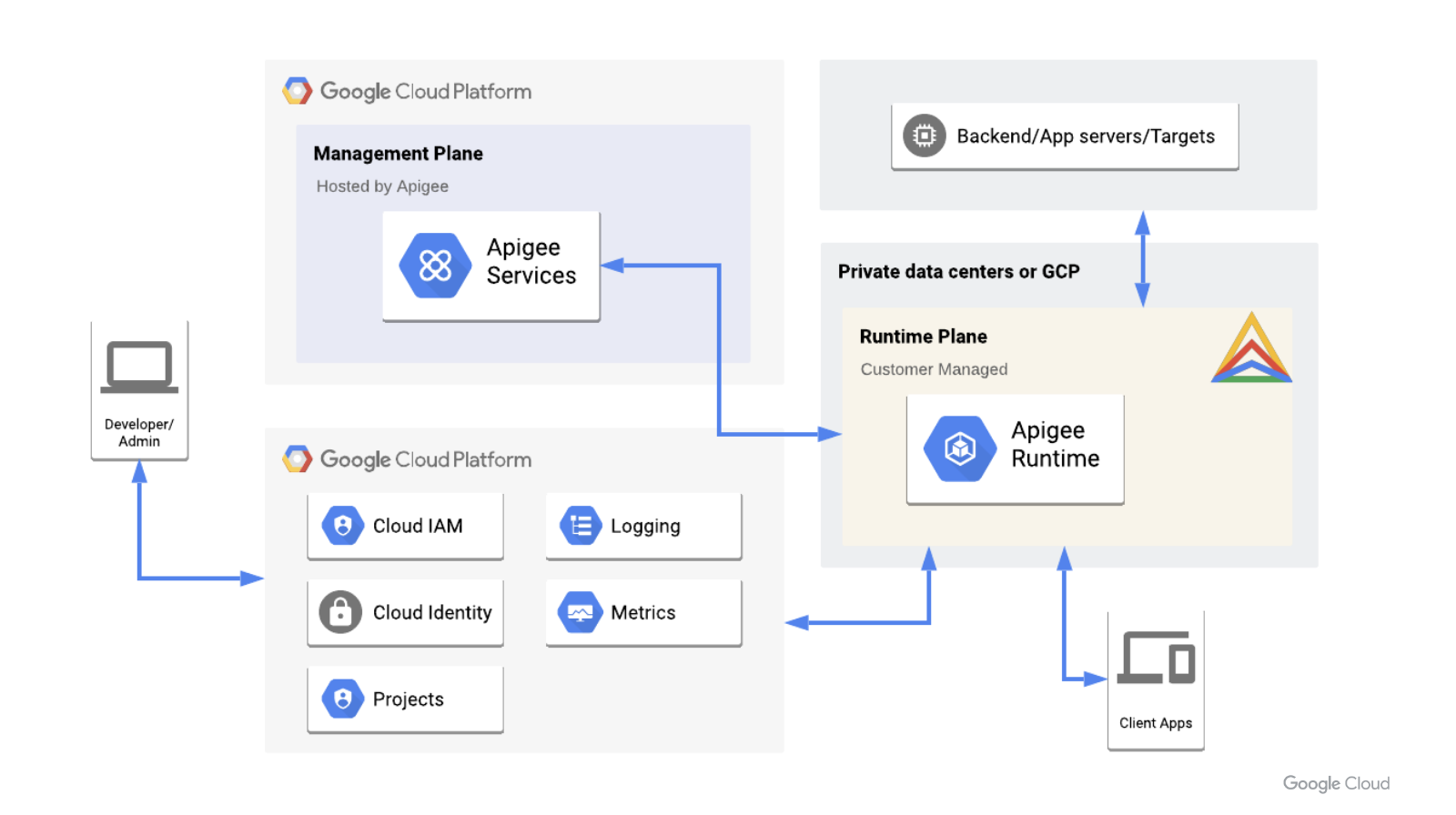
Apigee Hybrid solves this by splitting the platform in two.
The management layer runs in the cloud. The traffic layer stays wherever you need it, on-prem or in a private environment.
This setup works well for strict data rules and for systems that need very low latency.
Real-World Use Cases
What is Apigee used for across industries? Well, here’s how it plays out.
Retail & E-Commerce
Retail traffic is nowhere near steady. Rather, it’s explosive.
Events like Black Friday (and Cyber Monday, of course!) can push systems to their limits within minutes. Flash sales and product drops make things even worse. Traffic patterns become uneven and unpredictable.
Older architectures struggled here. Companies had to over-provision hardware just in case. Most of that capacity sat unused for most of the year. Meanwhile, backend systems, especially inventory and pricing databases, couldn’t handle massive concurrent read/write requests. Under pressure, they failed. As a result, systems locked up and revenue took a hit.
Apigee helps take that load away from critical systems.
Non-transactional data like product catalogs, pricing tiers, and images can be cached at the API layer or pushed through, say, Google Cloud CDN so that fewer requests hit the backend.
At scale, this matters. During peak retail periods, Apigee has handled traffic bursts of more than 100,000 transactions per second for retail workloads, while maintaining a near-perfect uptime of 99.999%. That kind of stability is what keeps checkout systems alive during the most important days of the year.
FinTech & Banking
Banking is being reshaped by regulation.
Frameworks like PSD2 force banks to open their systems to third-party providers. Apps for budgeting, lending, and payments now rely on direct access to banking data.
The problem? Most core banking systems were never designed for this. They’re closed, legacy environments built for isolation, not external access at scale.
Apigee is a secure, identity-aware proxy in front of those systems.
Every request is validated before it goes further. The platform checks third-party credentials and user consent, as well as limits the response to only approved data fields.
Security is enforced through standards like OAuth 2.0 and enhanced profiles such as Financial-grade API (FAPI), developed by the OpenID Foundation. These add threat protection like mutual TLS (mTLS) and proof-of-possession tokens, which reduce the risk of token hijacking or man-in-the-middle attacks.
Healthcare
Healthcare systems are full of critical data, yet most of it lives in silos.
Electronic Health Record systems store patient data using formats like HL7 and FHIR. These systems are often outdated and hard to integrate with modern apps.
At the same time, demand for digital healthcare has surged. Telehealth, mobile apps, and remote monitoring all depend on real-time access to patient data.
Apigee creates a secure API layer on top of these systems.
It translates older formats into modern REST/JSON responses, so new applications can use the data without rewriting legacy systems. Every request is authenticated, encrypted via TLS, and filtered through strict access controls.
The platform also works with cloud services like Google Cloud Storage and BigQuery to support real-time data pipelines.
A strong example is Rush University Medical Center. They built the “MyRush” mobile app, giving patients access to records, test results, prescriptions, and providers.
Behind the scenes, Apigee secures and manages communication between the app and multiple backend systems. Sensitive data stays protected, while patients get a smooth digital experience.
Telecommunications
Telecom companies face a different problem, which is growth.
Core services like voice and messaging have become commodities. Meanwhile, companies have invested billions in infrastructure like 5G and fiber networks.
To stay competitive, they need to turn those capabilities into products.
Apigee makes that possible.
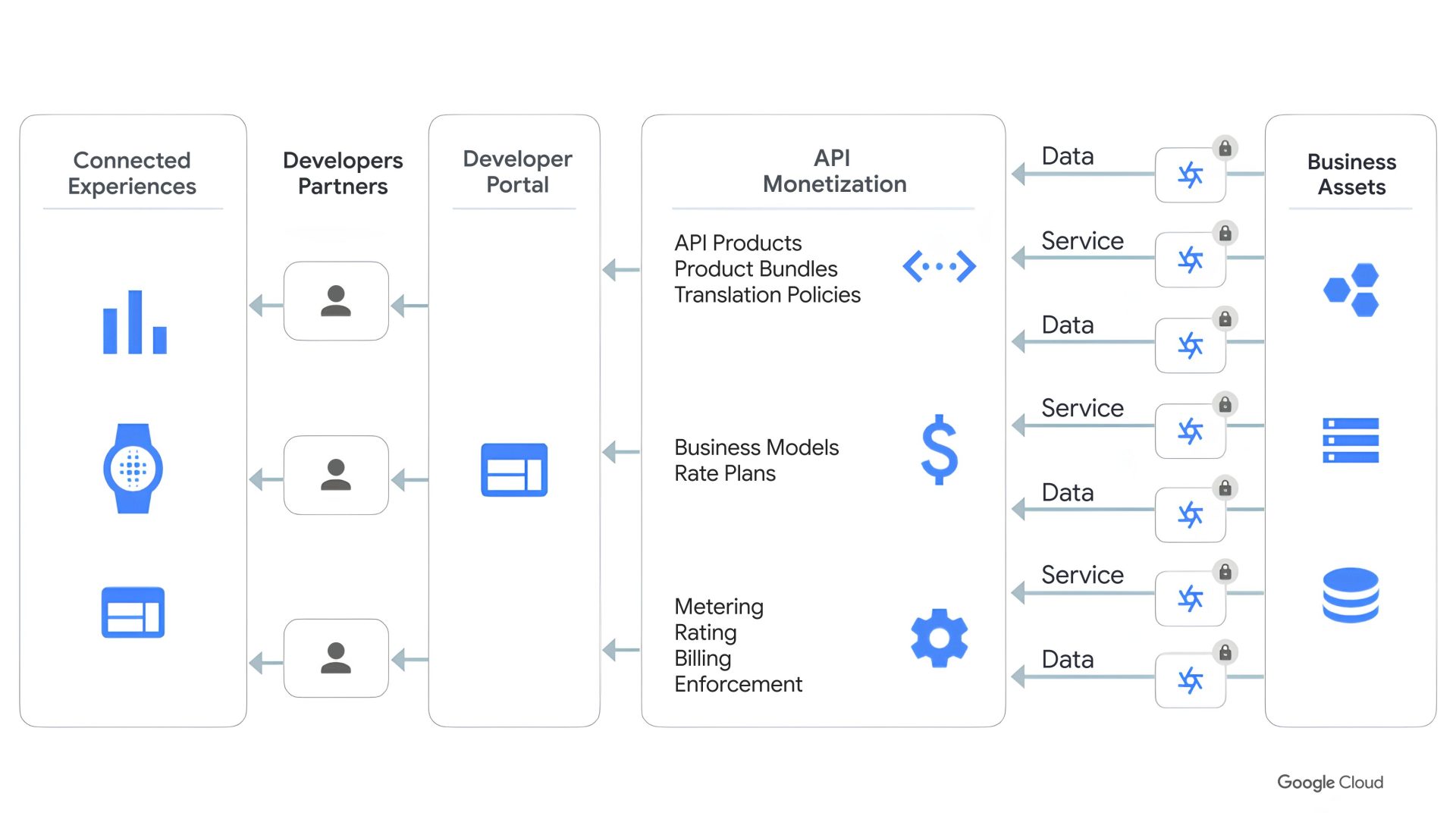
Internal services like SMS routing, identity verification, or carrier billing can be exposed as APIs. These APIs are packaged, managed, and monetized through a single platform.
What is Apigee handling?
- Usage tracking at scale.
- Rate limiting and quotas.
- Billing and pricing models.
- Developer onboarding via portals.
It supports multiple monetization strategies, from freemium tiers to usage-based billing.
A well-known example is Telstra.
They started out with a simple SMS API. They then launched a developer portal, offering free API calls to attract developers. From there, the company introduced paid plans for enterprise usage.
The result? 3,000 developers joined their ecosystem, and traditional telecom services became digital products.
Manufacturing & IoT
Manufacturing is going through a major change with Industry 4.0.
Factories now use sensors to track everything, from temperature and vibration to machine states. This data feeds into analytics systems to improve efficiency and predict failures.
But there’s a risk.
Operational Technology (OT), or the systems that control machines, was never meant to connect to the internet. Direct exposure creates serious security concerns.
Apigee acts as a controlled API gateway between OT and IT systems.
Data flows out via secure APIs, often using pipelines built on Cloud Pub/Sub. And control, well, it stays locked down. Yes, external systems can still read data, but they can’t manipulate machines.
Apigee also works with tools like Manufacturing Data Engine and edge connectors to normalize industrial protocols, such as Siemens PLC logs or SCADA system data.
You can view such a setup as a safe bridge. Companies get real-time insights without exposing critical infrastructure.
Media & Entertainment
Media platforms deal with two very different challenges: scale and intelligence.
On one side, there are traffic spikes. A major release or live event can bring millions of users at once. This creates the classic “thundering herd” problem.
On the other side, there’s content discovery. With huge libraries of video, metadata becomes essential.
What is Apigee helping you manage, then? The answer is, both sides.
For traffic, it works with systems like Google Kubernetes Engine and CDNs such as Media CDN. Requests are distributed across a scalable infrastructure. Frequently requested data—think of thumbnails, subtitles, and descriptions—is cached at the edge.
This reduces latency and keeps backend systems from being overwhelmed.
For content, Apigee connects storage with AI services like Vertex AI and the Cloud Video Intelligence API.
Here’s how it works:
- Video is uploaded to cloud storage.
- An API triggers AI analysis.
- The system extracts metadata—scenes, emotions, objects, dialogue, etc.
- Structured results are returned as JSON.
This replaces manual tagging and makes content easier to search and recommend.
To handle peak demand, platforms also rely on “cloud bursting.” Services scale up instantly during spikes and scale down when traffic drops. That keeps costs under control without sacrificing performance.
Is Apigee Right for You?
Not every company needs Apigee.
If you have only a few APIs, all used internally, a simpler setup might be enough.
But things change as you grow.
If you manage many APIs, work with external partners, face strict security rules, or want to monetize your data, then API management becomes key.
When complexity starts slowing you down, it’s time to step up.
The Cost of Doing Nothing
Relying on a patchwork of basic gateways and hardcoded middleware might seem okay at first, until you see the hidden costs.
As developers spend time manually coding security rules, access controls, and custom rate limits into every single app, your architecture becomes fragmented.
Documentation gets messy.
In the end, backends inevitably break under the pressure of unpredictable traffic spikes and scaling demands.
But the biggest cost is lost opportunity.
Every hour spent maintaining infrastructure is an hour not spent building features that move the business forward.
APIs determine how fast you grow, how well you scale, and how easy it is to work with you.
So the real question is simple: Are your APIs helping your business grow or holding it back?
About Cloudfresh: Your Apigee Partner
As a global Google Cloud Partner (tier: Premier), Cloudfresh provides the clear plan and dedicated support you need to adopt Apigee, a Gartner® Magic Quadrant™ Leader for ten years in a row.
- Architecture That Fits. The API layer works with what you already have and where you want to go next. Your systems stay connected, and the disruption is zero. Your teams are also consulted every step of the way.
- An Enterprise AI Gateway. Apigee secures, scales, governs, and optimizes your GenAI apps via multicloud model routing, semantic caching, token limit enforcement, and more. It’s also safely connecting AI agents to LLMs, databases, and systems via protocols such as UCP.
- Strong API Security and Control. You get centralized access, clear policies, and full visibility. Your data stays protected, and compliance becomes easier to handle.
- Built for Real Load. The system holds up under pressure. Your team can track API performance, adjust resources, and stay confident during peak traffic.
- Better User Experience. It’s easy for developers—inside and outside your company—to find and use your APIs. That translates to less friction, faster onboarding, and quicker launches.
- Growth and Monetization. You finally have an opportunity to turn APIs into products. From pricing models to partner ecosystems, you’re guided toward real revenue opportunities.
- Flexible by Design. Your setup works across cloud and on-premises environments. No lock-in. Just the flexibility to run your systems where it makes the most sense.
Have You Reached the API Tipping Point? Meet with our experts to assess all of your current APIs, find what’s slowing you down, and pick the right API management approach for your business. Book a Call →